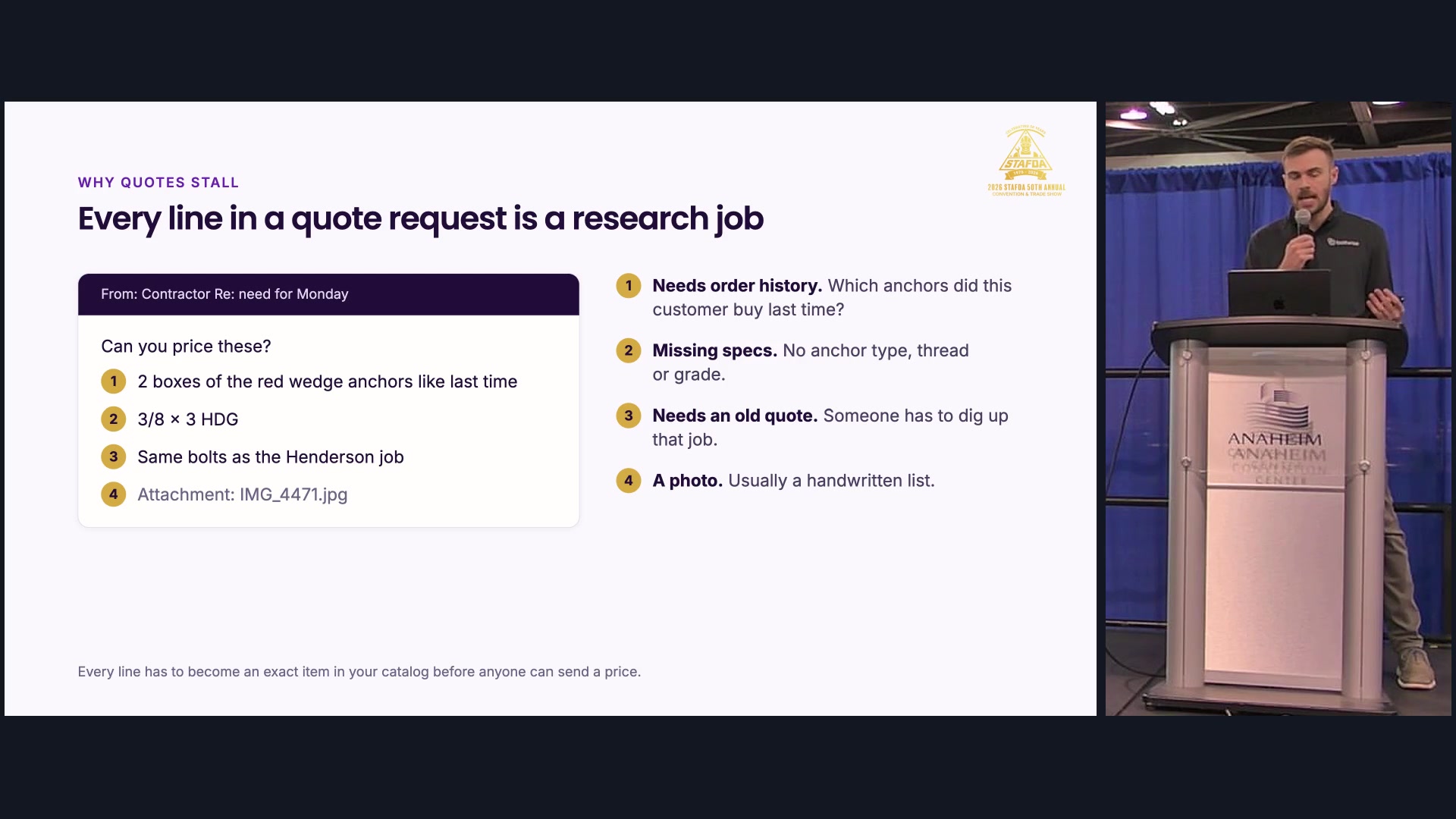
A customer emails you a request for 60 lines. One says “two boxes of the red wedge anchors like last time.” Another says “same bolts as the Henderson job.” There’s a photo attached.
Your rep opens the ERP to look up the anchors. The customer has bought more than one kind. The Henderson job was quoted by someone else, so that means asking around or digging through old emails. And the photo still needs somebody to read it.
You’re three lines in. You haven’t priced anything yet.
That’s where quotes stall in industrial distribution. Requests wait in the inbox, then reps spend hours figuring out which parts the customer means. At the STAFDA 2026 Spark Session, I talked about three things distributors can do about it. Measure how long quotes take, save the answers your reps find, and let software do some of the research.
Ask a distributor what they made on a sale and they can usually tell you down to the decimal. Ask how long it took to get that same quote out the door and the answer gets a lot less precise.
Time-to-quote is the time between receiving a request for quote (RFQ) and sending the quote back. That includes the time it sits in the inbox. The clock starts when the customer hits send and the request reaches your team.
Take the 60-line request I walked through at STAFDA. In that example, it sat for two hours, took three hours to research and enter, and spent another 20 minutes in review. Five hours and 20 minutes from inbox to send. If I had to pick one place to start, I’d look at the three hours of research and entry.
Pull up last week’s quotes. How many went out? What was the median turnaround? How many took more than 24 hours? Look at the numbers by rep and customer, then pull up a few of the actual requests. If one rep has the longest turnaround and also gets every messy bid, you’ve just learned something about where the hard work lands.
Think about the rep everyone goes to when they can’t find a part. They know what “the usual” means for a particular customer, which competitor part numbers cross to your catalog, and which supplier to call when you’re out of stock.
One distributor we spoke with had a rep who’d been doing this for 35 years. As he started looking at retirement, the team had a practical question. How do you get all those answers into a place where somebody else can find them?
Start with the next answer someone confirms. A shared cross-reference sheet will do. Put down the customer, the words they used, and the item number your rep verified. Keep it tied to the customer. Two customers can both ask for red wedge anchors and mean two different parts.
The next time that email comes in, the rep can check stock and price instead of going back through old orders. A new hire can do the same thing on their first week.
Quoting automation can look through your catalog and sales history, suggest the part the customer likely means, and show the rep what it found.
Go back to the red wedge anchors. If the customer’s past orders point to a 3/8 × 3 hot-dip galvanized anchor, the software can bring up that part and the orders behind it. The rep can see why it came up, confirm the match, check stock, and set the price. If there’s a question about the finish or an acceptable substitute, the rep can ask the customer before the quote goes out.
The quality of the suggestion depends on what’s in the item master and sales history. If several SKUs look identical in your catalog, a rep still needs enough information to tell them apart. That’s where a final check matters.
One fastener distributor we work with had a 3,000-line bid. BoltWise matched 2,100 lines to catalog items for review. That’s 70% of the bid. A rep could review a suggested match in about 30 seconds. The remaining 900 lines were outside the catalog and needed to be sourced from suppliers.
The distributor got the bid out in days. Similar bids had taken weeks.
I asked what they did with the time they got back. They told me their team was spending more of it on the road visiting customers. These were people who’d been spending that time behind a desk working on quotes.
If you’re wondering where to start with quoting automation, pick one of the big, messy RFQs your team already has in its inbox. The one with competitor part numbers, customer shorthand, and an attachment somebody has to work through line by line.
Write down when it came in, when someone picked it up, and when it went out. See how many lines your reps can match from the catalog, how many need supplier sourcing, and which answers are worth keeping. The next time a similar bid comes in, you’ll have something to measure it against. And the next time a customer asks for the red wedge anchors, you’ll already know where to look.